Advice and Support
Mental Health & Wellbeing
At St Thomas' we take supporting children, staff and families mental health really seriously. We know that happy and settled children learn better. Mrs Pierpoint is our schools trained Senior Mental Health Lead. You can also talk to any member of the safeguarding team about any worries or concerns and they can support and signpost you to appropriate advice.

In school we work on a Wave1, 2 and 3 support sytem. Universal mental health and well being support for all, to targetted small group and 1:1 support to specialist support and provision where required. Please download the mental health and well-being provision map at the bottom of this page to see the support offered in school.
In School - Sip and Support
 |
We are really fortunate to work closely with the NHS Mental Health Support Team (MHST). Our link, Hannah Turner, is often in school, working with children 1:1, small group or whole class. In addition to her work with children, Hannah offers monthly Sip and Support sessions for our families. If you have any worries or questions, call in on one of the following dates, grab a cuppa and get some advice. (Dates on poster) Upcoming dates are shared via dojo and on our newsletter. Please ring or email the school office more information future dates. 01782 787099 or office@stthomascofeacademy.org |
NHS Mental Health Support
Anyone across Staffordshire and Stoke-on-Trent can access 24/7 mental health support by text through two free text services across the area.
The text services are delivered by Midlands Partnership University NHS Foundation Trust (MPFT) and North Staffordshire Combined Healthcare NHS Trust (NSCHT), commissioned by Staffordshire and Stoke-on-Trent Integrated Care Board (ICB).
Children, young people and adults can text the following numbers to receive support for their mental health at any time of the day or night.
Text for support:
For North Staffordshire and Stoke-on-Trent – 07312 263117 (NSCHT).
For South Staffordshire – 07507 330605 (MPFT).
Anyone feeling unsafe, distressed or worried about their mental health can also call NHS 111 and select the mental health option. The text service is not for urgent or emergency support; the NHS advises people to call 999 if there is a serious risk to life.
Our Community Guide
At St Thomas', we are proud to share our Community Guide, which brings together a wide range of advice, services, and support groups available to families in our local area. The guide is designed to help parents and families easily access support for health and wellbeing, childcare and early years, family hubs, SEND services, libraries, local clubs, and community organisations. By working closely with trusted local partners, we aim to ensure that our school community feels supported, informed, and connected. Whether families are looking for practical help, social opportunities, or specialist advice, our Community Guide highlights the many resources available to promote positive outcomes for children and families in Kidsgrove and surrounding areas.
Please download the community guide at the bottom of this page to see the support in our local area.
Togetherness – Free Online Support for Families
Togetherness is a free online learning resource designed to help parents, carers and families build emotional resilience, confidence and wellbeing at every stage of life. It gives practical support from antenatal through childhood, adolescence and into adulthood — including advice on sleep, emotional health, relationships and everyday family life.
Togetherness is based on the evidence-based Solihull Approach and developed with input from NHS clinical psychologists and specialist professionals, so you can trust the information and guidance you’ll find.
What you can learn:
• Emotional resilience and confidence for you and your family
• Understanding your baby from pregnancy and birth onwards
• Child development and behaviour across the ages
• Teen emotional wellbeing and brain development
• Support with relationships, emotional health and family life
• Sleep wellbeing for babies, children and adults through dedicated resources like Sleepfullness
Who is it for?
Togetherness is ideal for:
• Expectant parents
• Parents and carers of children and teens
• Families looking to build confidence and emotional skills together
How to access:
You can begin your free learning journey by visiting the Togetherness website: https://togetherness.co.uk/learn
The courses are self-paced and accessible online, so you can work through them at a time that suits your family.
Support with Back to School Worries.
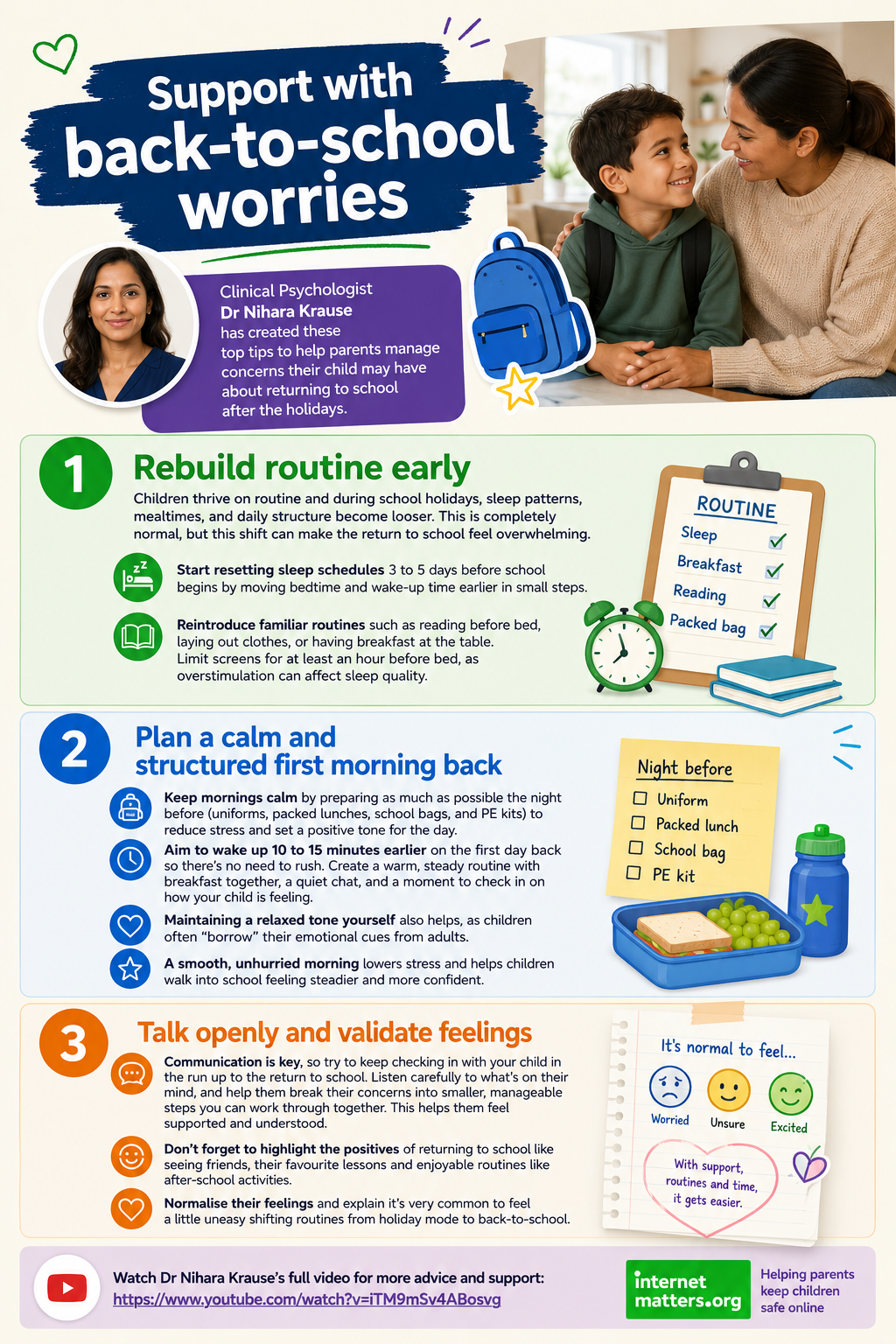
Clinical Psychologist Dr Nihara Krause has created these top tips to help parents manage concerns their child may have about returning to school after the holidays.
1. Rebuild routine early
Children thrive on routine and during school holidays, sleep patterns, mealtimes, and daily structure become looser. This is completely normal, but this shift can make the return to school feel overwhelming.
Start resetting sleep schedules 3 to 5 days before school begins by moving bedtime and wake-up time earlier in small steps.
Reintroduce familiar routines such as reading before bed, laying out clothes, or having breakfast at the table. Limit screens for at least an hour before bed, as overstimulation can affect sleep quality.
2. Plan a calm and structured first morning back
Keep mornings calm by preparing as much as possible the night before (uniforms, packed lunches, school bags, and PE kits) to reduce stress and set a positive tone for the day.
Aim to wake up 10 to 15 minutes earlier on the first day back so there’s no need to rush. Create a warm, steady routine with breakfast together, a quiet chat, and a moment to check in on how your child is feeling.
Maintaining a relaxed tone yourself also helps, as children often “borrow” their emotional cues from adults.
A smooth, unhurried morning lowers stress and helps children walk into school feeling steadier and more confident.
3.Talk openly and validate feelings
Communication is key, so try to keep checking in with your child in the run up to the return to school. Listen carefully to what’s on their mind, and help them break their concerns into smaller, manageable steps you can work through together. This helps them feel supported and understood.
Don’t forget to highlight the positives of returning to school like seeing friends, their favourite lessons and enjoyable routines like after-school activities.
Normalise their feelings and explain it’s very common to feel a little uneasy shifting routines from holiday mode to back-to-school.